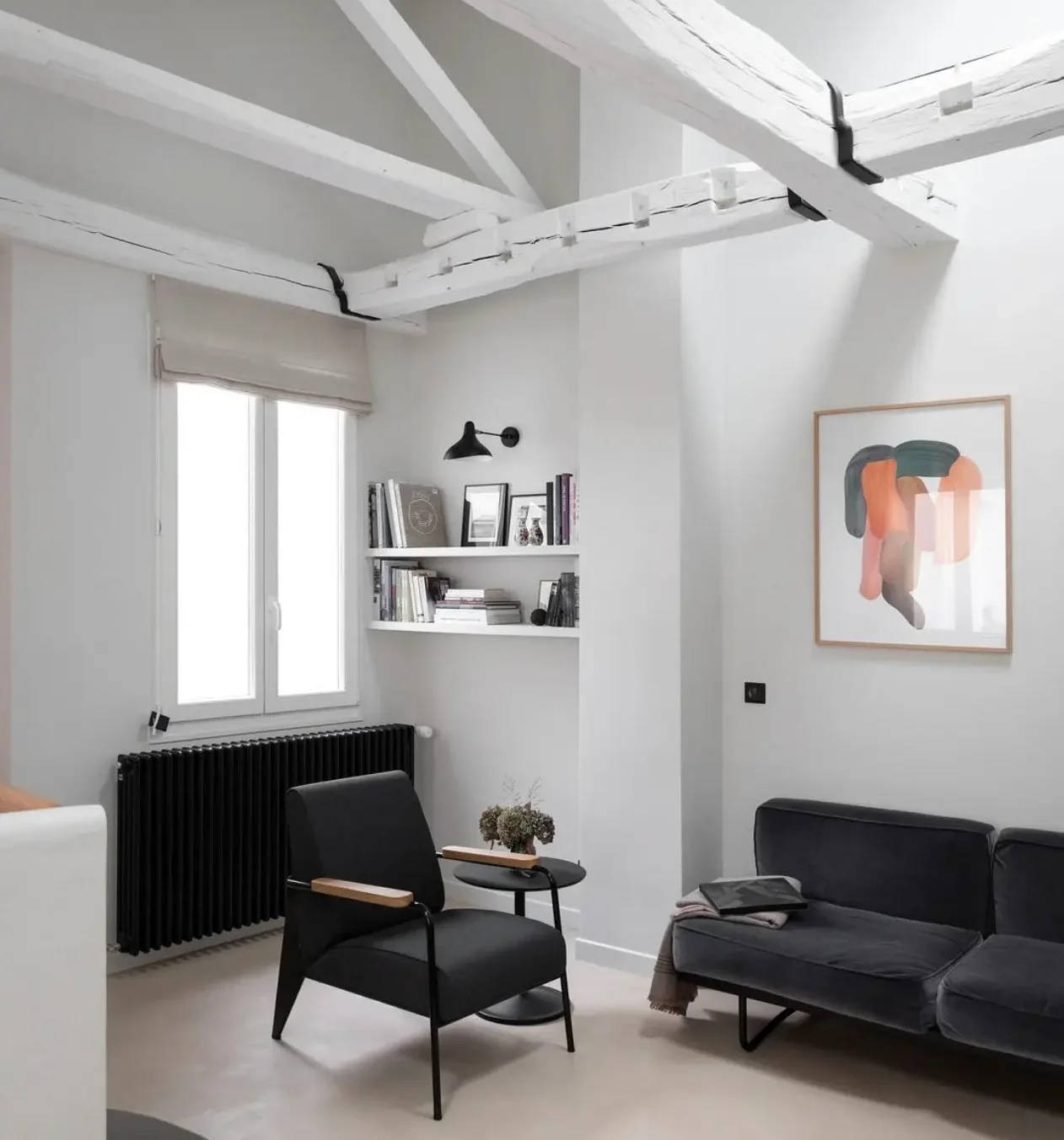
Roman Blinds: Definition and Characteristics
A Roman blind is a fabric window covering that folds into large horizontal pleats when raised. Unlike a traditional curtain, it combines the softness of textile with the structure of a blind.
Its operation relies on a discreet mechanism made up of cords or rails that allow the fabric to rise smoothly and evenly.
Unlike fixed display blinds inspired by Japanese noren and used as decorative semi-open textile panels, the Roman blind remains movable and allows light modulation thanks to its lifting system.
Roman blinds naturally find their place in a living room, bedroom, or office, as their appearance provides both visual comfort, light control, and a refined decorative finish.
Aesthetics and Functionality
The fabric is the central element of a Roman blind. The upholsterer-decorator adapts the selection to each interior or exterior by offering materials, textures, and opacity levels that match the desired atmosphere. Custom-made design makes it possible to create a blind perfectly suited both to the room’s function and to its decorative identity.
For example, a very lightweight sheer fabric allows light to pass through while gently filtering it, creating a bright atmosphere ideal for living spaces such as the living room or kitchen.
Blackout fabric, on the other hand, effectively blocks outside light, making it particularly suitable for bedrooms or spaces requiring controlled darkness.
The choice of mechanism also contributes to both the aesthetics and ease of use of the blind. Depending on the desired effect, several finishes are possible: a simple Roman blind with metal eyelets, an American-style blind with rods and rings (sewn either at the front or back), or a London blind featuring visible rods and eyelets for a more decorative style.
It is also possible to opt for a Roman blind without rods: in this case, the rings are positioned at the back, resulting in a softer and more discreet appearance.